
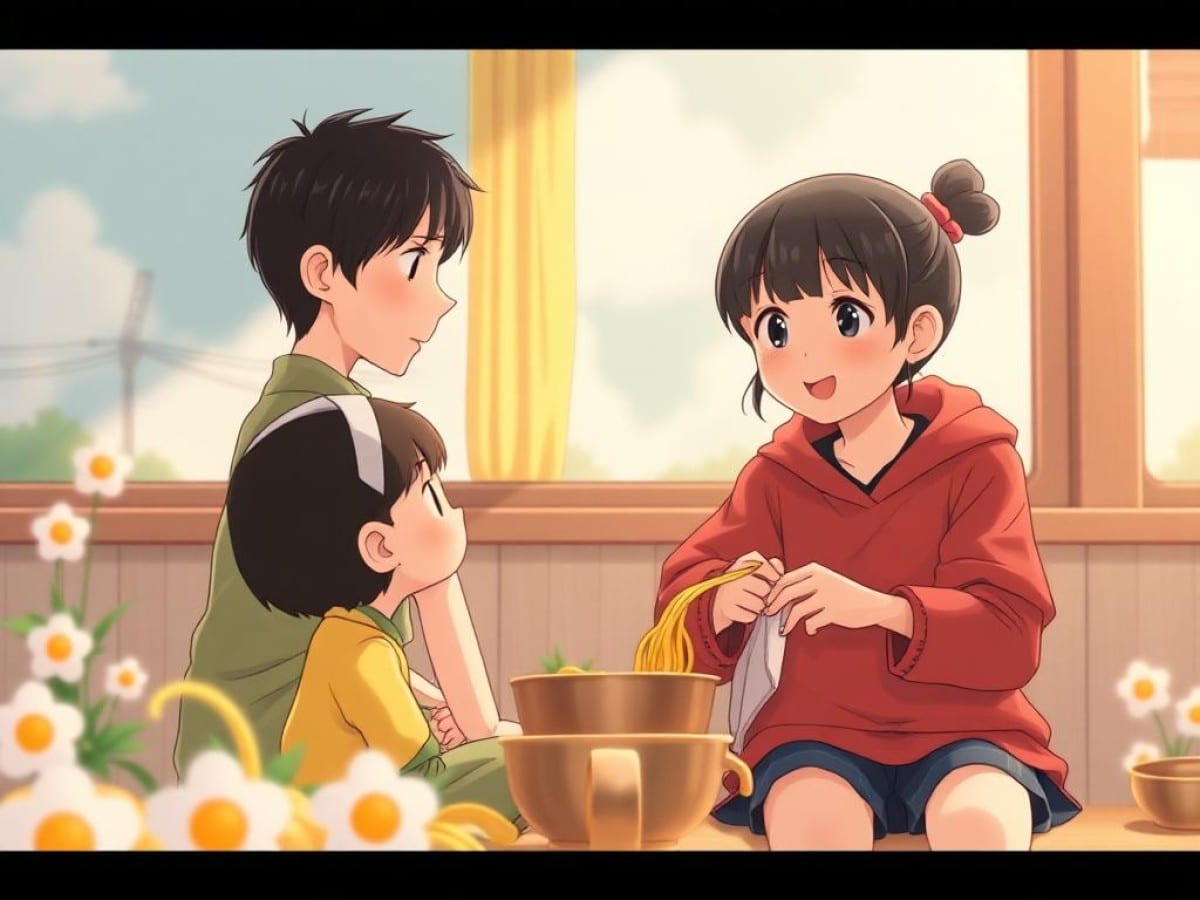
Whenever Masaaki Yuasa announces a new project, expectations for visual excellence are naturally high. His latest project, “Daisy’s Life,” promises to push these boundaries even further than his previous works. This new venture, a collaboration between his newly established studio ame pippin and France’s Miyu Productions (“Ghost Cat Anzu”), explores the extraordinary friendship between two young girls, Daisy and Dahlia, whose relationship defies the constraints of time and space.
The narrative, inspired by Banana Yoshimoto’s book and complemented by art from Yoshimoto Nara, is seen by producer Fumie Takeuchi as a thematic extension of Yuasa’s earlier film “Inu-Oh,” which was his parting project with studio Science Saru. That film delved into the bond between two boys united by their passion for music and theatre, culminating in a reflection on how stories outlive the physical existence of beings. “Daisy’s Life” scales up this concept, exploring how the moments shared by Daisy and her companions could resonate across any era.
The presentation of the film at the event was less about concrete details and more focused on the emotional depth and conceptual drivers behind the visual style. Attendees were treated to brief, incomplete snippets of the film, including a scene shot from the perspective of one of the girls wandering through a forest and playing a recorder, and another scene crafted by renowned animator Norio Matsumoto, known for his work on “Naruto” and “Inu-Oh,” depicting a homey, yet surreal setting.
Popular on The Bangin Beats
In a reflective moment, Yuasa shared insights into his personal life, revealing his existential concerns at 20 about life and death. This led him to appreciate the idea of a life catalogued in a library book, a concept that resonates through his filmmaking. Comparing books and animation, Yuasa suggested that both mediums serve as portals to relive the experiences of others, be they set in medieval times or futuristic worlds. This philosophical underpinning shapes the essence of “Daisy’s Life,” although no specific film visuals were shown to illustrate this point.
During the event, Yuasa demonstrated his thoughts using several props. He first struggled with a two-volume edition of Yoshimoto’s book, packed tightly to symbolize its dense experiential content. He then delved into his fascination with the fourth dimension, describing a non-linear perception of time where all moments exist simultaneously, providing comfort even in sorrow by knowing joyful moments are occurring elsewhere at the same time.
Yuasa compared these time-bending ideas to the film “Interstellar,” noting personal and thematic connections to “Daisy’s Life.” He further illustrated his concept using a tunnel book, a three-dimensional paper structure that unfolds to reveal sequential historical events, which he then collapsed back into a single layer, symbolizing the simultaneous existence of a person’s life experiences as portrayed in his upcoming film.
Speaking on the collaboration with Miyu Productions, visual development artist Batiste Perron, who previously interned at Science Saru, discussed the technical challenges in capturing the film’s unique visual style, including working on scenes set in a magnified garden where leaves tower over the protagonists.
236M views in 10 weeks: how KPop Demon Hunters dethroned Red Notice
Materialists Raises Eyebrows: Sharp Satire or Elitist Attack on Modern Love?
Park Chan‑wook’s 2025 Venice Comeback: 6‑Minute Ovation and a 20‑Year Return
Julia Roberts’ 6‑minute ovation at Venice 2025 — the quote already igniting awards talk
Character design discussions were particularly poignant. Designer Izumi Murakami expressed a strong stance against the sexualization of young characters, a prevalent issue in Japanese media. She emphasized her commitment to respectful representation, a concern swiftly understood and supported by Yuasa.
Murakami also mentioned the challenge of adapting Nara’s minimalist style, which omits necks, eyebrows, and ears—elements typically crucial for animated expression. Despite these limitations, she found effective ways to convey emotions through the characters.
The complexity of adult characters, differing from the children by features like eyebrows, posed further design challenges. Murakami initially attempted to adapt a reference from Yuasa but eventually had to discard this approach and develop the adult character designs from scratch to better align with her artistic vision.
Perron touched on the representation of synesthesia in the portrayal of food within the film, drawing inspiration from Pixar’s “Ratatouille.” Food, integral to the family narrative in “Daisy’s Life,” is depicted as emotionally rich, mirroring the film’s broader ambition to encapsulate the full spectrum of human experience through animation.
Similar Posts
- This “Grandmother” Is Not Real: Daisy, The Ai That Humiliates Fraudsters On The Phone, Manages To Fool Everyone
- Zelda Movie Cast Revealed: Nintendo Confirms Lead Actors for Live-Action Film!
- Lily James, Gala Gordon Start Parodos: A New Hub for Female Resilience Stories! (EXCLUSIVE)
- Kojima Productions Livestream Recap: Discover All the Latest Announcements!
- Young Thug & Future Drop “Money on Money” Video: See the Epic Visuals Now!

With a knack for uncovering hidden gems, Blake dives deep into the world of indie films and underground cinema.