
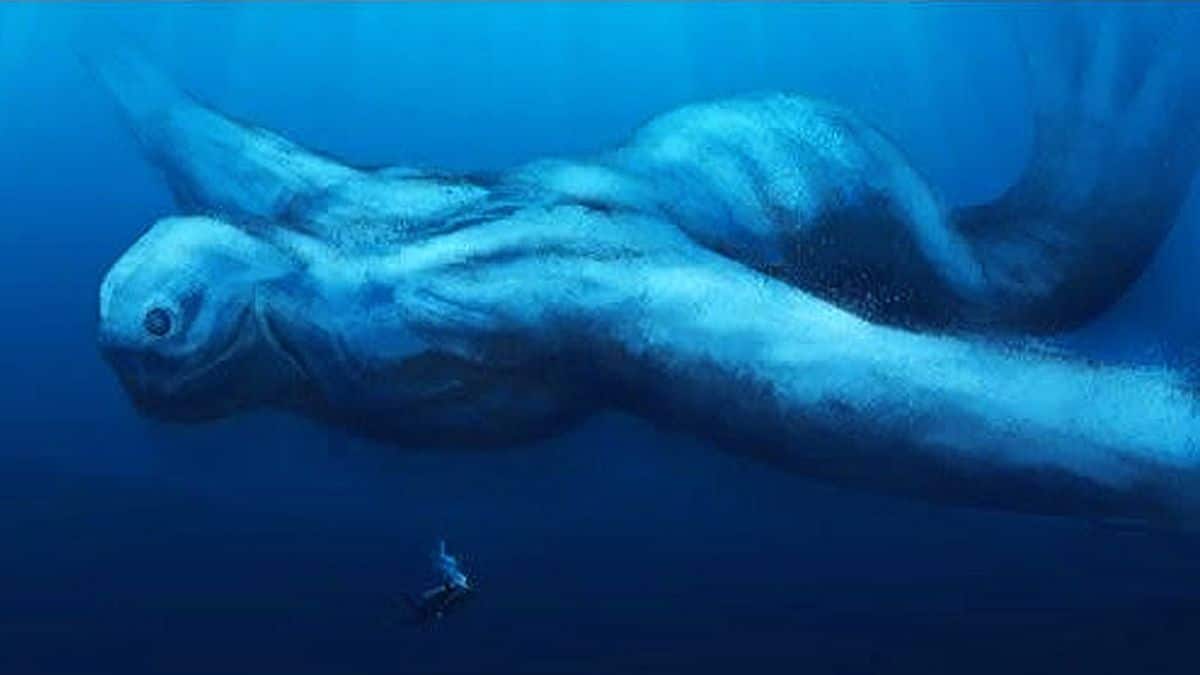
The abyss reveals its secrets: a fascinating creature filmed at a depth of 5,000 metres
An exceptional discovery in the ocean depths has shaken up our knowledge of abyssal life. Researchers have captured never-before-seen images of a mysterious creature, the Iosactis vagabunda, a unique anemone evolving in the darkness of the deep sea.
An abyssal nomad with surprising abilities
This small anemone, barely 2.5 centimetres long, defies the conventions of its species. With its 24 tentacles, it stands out for its exceptional mobility, unlike its sedentary cousins.
Scientists have documented its ability to dig burrows and move regularly, a rare behavior that intrigues the scientific community.
A formidable predator despite its size
Observations revealed a spectacular feeding behavior: Iosactis vagabunda preys on prey up to four times its size.
The researchers filmed a striking scene in which the anemone devours a 10-centimeter polychaete worm for over 16 hours, visible through its translucent body.
A major scientific mission
Over a 20-month period, the researchers carried out an in-depth study of 18 specimens in the Porcupine Abyssal Plain, off the coast of Ireland.
The mission collected over 29,000 usable images, thanks to sophisticated equipment capable of withstanding the extreme pressures of the deep sea.
An essential link in the abyssal ecosystem
Beyond its singularity, this anemone plays a crucial role in the balance of deep-sea ecosystems.
Its movements and feeding habits actively contribute to the ocean carbon cycle, a process that is fundamental to the health of our planet in the face of the challenges of climate change.
236M views in 10 weeks: how KPop Demon Hunters dethroned Red Notice
Materialists Raises Eyebrows: Sharp Satire or Elitist Attack on Modern Love?
Park Chan‑wook’s 2025 Venice Comeback: 6‑Minute Ovation and a 20‑Year Return
Julia Roberts’ 6‑minute ovation at Venice 2025 — the quote already igniting awards talk
Impact on climate research
The study of these abyssal organisms is becoming essential in the context of global warming. The oceans, which absorb much of the excess heat, are seeing their deep-sea ecosystems evolve.
Understanding these changes could open up new perspectives in the fight against climate change.
Conclusion
This discovery is a reminder that the oceans still conceal countless mysteries. Iosactis vagabunda, with its unique characteristics, perfectly illustrates the complexity and richness of abyssal life.
Its study opens up new perspectives for understanding deep-sea ecosystems and their role in the global climate balance.
Source: CafeBabel
Similar Posts
- The discovery no one expected: has a new ocean really just been discovered 700km below Earth’s Surface ?
- It’s neither a monkey nor a robot: here is the animal that could rule the Earth after humans
- According to one study, the ocean is getting darker – and that’s very bad news!
- Scientists attach GoPRo cameras to polar bears and discover that they have transformed themselves
- He gets bitten 200 times on purpose by venomous snakes: the revolutionary discovery that could finally save millions of lives

A pop culture aficionado with a sharp eye for trends, Jason covers everything from Hollywood blockbusters to viral internet moments.