
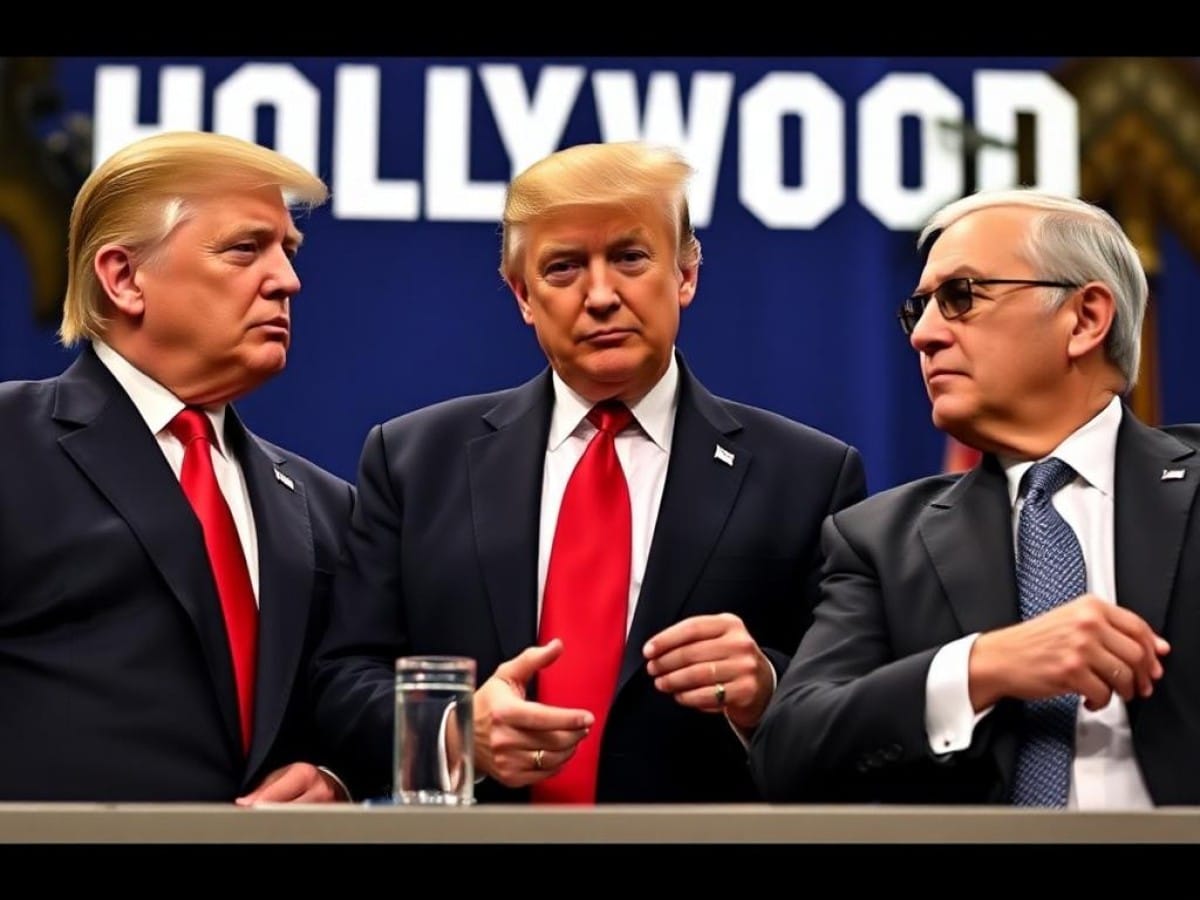
Donald Trump has a jam-packed agenda this week. On Monday, he engaged in discussions at the White House with Israeli Prime Minister Benjamin Netanyahu, aiming to secure support for his strategy to terminate the conflict in Gaza. That same day, he also convened with the foremost leaders of Congress, striving to finalize a governmental funding agreement to prevent a shutdown by the September 30 deadline. Amidst these activities, Trump launched a series of new threats on social media, proposing tariffs on foreign-made films.
On his platform Truth Social, Trump claimed that the film industry has been “taken away from the United States by other countries, as easily as taking ‘candy from a baby’,” and announced his intent to “implement a 100% tariff on any foreign-made movies.”
The sudden announcement took movie studios and streaming services by surprise, as there had been no prior consultations with them or the Motion Picture Association before the declaration. This move mirrors a similar threat issued by Trump last May. The industry remains unsure of how to react to this unexpected stance, harboring doubts about whether Trump will follow through, especially since he abandoned the topic last spring amid unresolved questions on how such tariffs could be applied to films, which are considered “services” rather than “goods.”
“As the President, his words carry weight, but people are predominantly baffled by this,” remarked one executive from a film studio.
While the Motion Picture Association has not issued a public statement, sources indicate that a board meeting scheduled for Tuesday is likely to feature discussions on Trump’s tariff threats. Prominent figures in the entertainment industry, such as Disney’s Alan Bergman, Amazon MGM’s Mike Hopkins, and NBCUniversal’s Donna Langley are expected to attend this quarterly meeting. Discussions among government relations teams from various studios were anticipated to start on Monday, as per one industry insider.
The international film community has reacted to Trump’s renewed tariff threats with a mixture of concern, confusion, and a significant degree of skepticism.
The rationale behind Trump’s latest tariff threat, issued just months after a similar declaration, remains unclear. The prior announcement also lacked specifics regarding the enforcement and impact of such tariffs, and to date, no policies have been implemented.
“Trump mentioned imposing tariffs on movies a few months back without providing any details. It’s unclear who would be responsible for paying these tariffs,” commented Stephen Weizenecker, an entertainment lawyer at Barnes & Thornburg. “But since he’s bringing it up again, perhaps he has a plan in mind.”
236M views in 10 weeks: how KPop Demon Hunters dethroned Red Notice
Materialists Raises Eyebrows: Sharp Satire or Elitist Attack on Modern Love?
Park Chan‑wook’s 2025 Venice Comeback: 6‑Minute Ovation and a 20‑Year Return
Julia Roberts’ 6‑minute ovation at Venice 2025 — the quote already igniting awards talk
However, unlike the initial announcement which caused widespread confusion across the international film industry, this latest declaration has largely been met with dismissive reactions.
“It seems like more of the same bluster. It’s typical of his outlandish style,” said Phil Hunt, a British producer and co-managing director of Head Gear Films. “I don’t see it benefiting North America. He fails to grasp the complexities of the global nature of the film industry.”
The White House did not respond to repeated inquiries for comments or clarifications.
Kayvan Mashayekh, head of Producers Without Borders, acknowledged the frustration over productions moving overseas but criticized the simplistic approach of the tariffs, pointing out that the issue is not straightforward.
With the increasing globalization of film production, the concept of a movie’s nationality is becoming obsolete. Many leading U.S. filmmakers are collaborating with European producers and financiers, and major studio blockbusters are opting to shoot in countries like the United Kingdom and Hungary, which offer more attractive subsidies compared to the U.S.
Charles Gillibert, a French producer involved in projects like “Coutures” featuring Angelina Jolie, expressed concerns that Trump’s tariffs could disproportionately harm independent films more than big studio productions.
“Filming in the U.S. is already prohibitively expensive for many independent films. This tariff could target those kinds of films because they often offer a critical perspective on U.S. politics and society,” he explained.
Ironically, the artists most affected by the tariffs are often those who serve as cultural ambassadors for American cinema on the global stage. For example, Jim Jarmusch, who recently won the Golden Lion at Venice for “Father Mother Sister Brother,” shot primarily in Ireland and France.
“If the president truly wishes to support the American film industry and create more jobs in the U.S., he should collaborate with Congress to establish incentives that can compete with those available in Europe and elsewhere,” proposed Joshua Astrachan, a New York-based producer.
Congresswoman Laura Friedman from Burbank mentioned ongoing discussions with colleagues, including some Republicans, about introducing a federal tax credit to support the film industry.
“We’re still hopeful that there are influential figures within Trump’s circle who can steer him towards a more logical solution,” she stated, emphasizing the alignment among producers, unions, and studios in favor of such federal support.
Raphael Benoliel, a prominent line producer who has overseen numerous U.S. productions in France, advocates for a cautious approach until more concrete proposals are presented.
“For now, we should adopt a wait-and-see attitude because he often reverses his statements,” Benoliel noted. “He likes to stir up chaos, but I prefer to remain calm and patient.”
Northern Irish producer Trevor Birney, behind the BAFTA-winning “Kneecap,” responded more bluntly to Trump’s statements. “Go fuck yourself! Again!” he exclaimed, speculating that Trump’s latest outburst might be a reaction to recent disappointments in U.S. sports. “It seems he didn’t take the Ryder Cup loss very well!”
Rebecca Rubin and Gene Maddaus contributed to this report.
Similar Posts
- Trump’s Movie-Tariff Buzz: Studio Heads Focus on California Production Incentives Reform
- Nintendo Switch 2 Pre-Order Delayed in U.S.: Tariff Impact Assessment by Trump’s Policies
- “What the hell is Elon doing here?” Donald Trump prevents Musk from attending to a briefing
- Donald Trump Takes Charge at Kennedy Center: Drama Unfolds Amidst Organizational Upheaval
- ‘Dragon’ and ‘Lilo & Stitch’ Conquer China: Films Triumph Despite Trade Tensions!

With a knack for uncovering hidden gems, Blake dives deep into the world of indie films and underground cinema.