
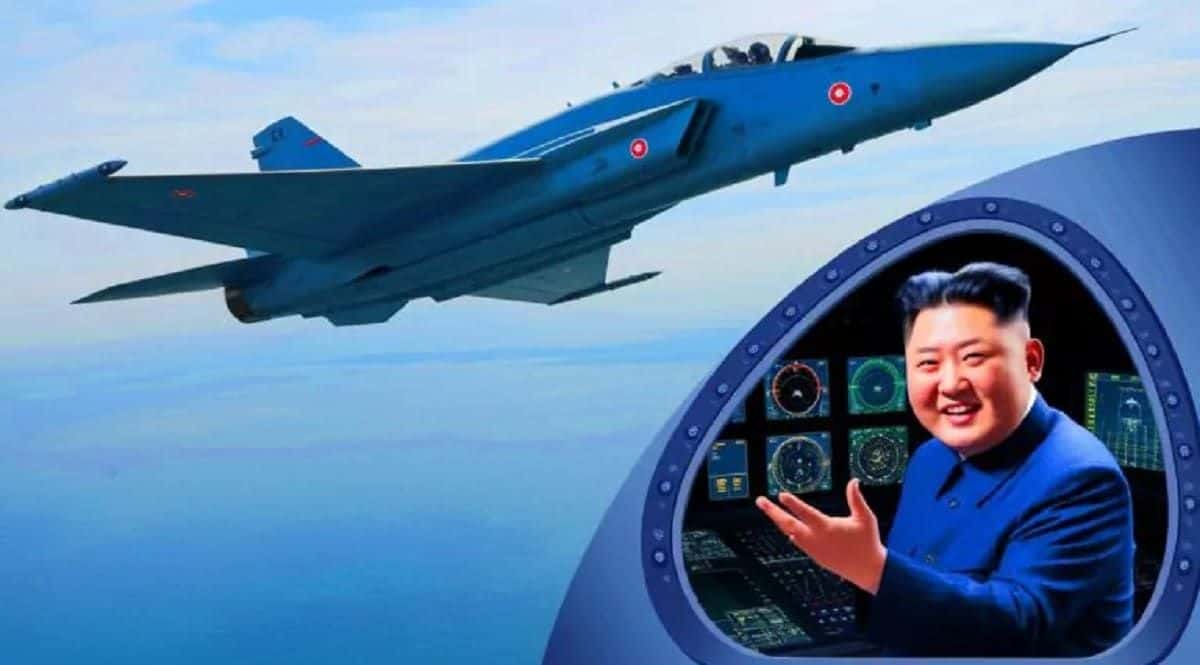
A revolution in North Korean skies
North Korea has taken a major technological step forward with its new Airborne Early Warning and Control (AEW&C) aircraft. Based on the Russian Il-76, this aircraft represents a significant advance in the country’s aerial surveillance capabilities. Kim Jong-Un personally supervised the project, which marks a break with the rudimentary systems used until now. The aircraft features a fixed radome incorporating three phased-array radars, providing 360-degree coverage.
Cutting-edge technology made in North Korea
The interior of the aircraft reveals an unexpected level of sophistication. Workstations equipped with state-of-the-art flat-screen monitors enable real-time processing of surveillance data. This modern configuration suggests advanced information processing and air operations coordination capabilities.
However, managing such a system requires highly qualified personnel, raising questions about North Korea’s real capacity to exploit these technologies to the full.
Impact on regional balance
This new acquisition upsets the security dynamic in East Asia. The aircraft enables North Korea to considerably extend its radar coverage and improve its ability to detect airborne threats.
This advance is of particular concern to South Korea and the United States, as it significantly strengthens North Korea’s defensive capabilities, while paradoxically constituting a vulnerable strategic target.
The mystery of international collaboration
The development of this AEW&C raises questions about the foreign aid received. Similarities with Russian and Chinese models suggest possible technical collaboration, although this has not been officially confirmed.
The presence of similar aircraft in countries such as India and Iran suggests the existence of a network for the exchange of advanced military technologies.
The future of North Korean military power
This acquisition is part of a broader strategy of military modernization. It demonstrates North Korea’s growing ability to develop sophisticated military technologies, despite international sanctions.
This development could presage further major technological innovations in North Korea’s arsenal.
236M views in 10 weeks: how KPop Demon Hunters dethroned Red Notice
Materialists Raises Eyebrows: Sharp Satire or Elitist Attack on Modern Love?
Park Chan‑wook’s 2025 Venice Comeback: 6‑Minute Ovation and a 20‑Year Return
Julia Roberts’ 6‑minute ovation at Venice 2025 — the quote already igniting awards talk
Conclusion
The introduction of this radar aircraft marks a turning point in North Korea’s military capabilities, and alters the strategic balance in East Asia. While the aircraft’s actual performance remains to be confirmed, its very existence testifies to a significant evolution in the country’s technological capabilities.
This advance raises legitimate concerns about regional stability and could lead to a new arms race on the Korean peninsula.
Similar Posts
- The United States On High Alert: The Pentagon Confirms That A Mysterious Signal Has Been Attributed To A Russian Space Anomaly, Now Considered A Major Threat
- Could This Chinese Beetle Make U.S. Missile Defense Obsolete?
- A shocking statement: the US military is betting billions of euros on this hidden energy that could change the future of the entire world
- Hvaldimir May Not Have Been Just A Beluga Whale: Disturbing New Revelations About This Russian Spy Of The Sea
- China revolutionizes future transport: 1000 km/h trains, a technological feat that defies the laws of physics

A pop culture aficionado with a sharp eye for trends, Jason covers everything from Hollywood blockbusters to viral internet moments.