
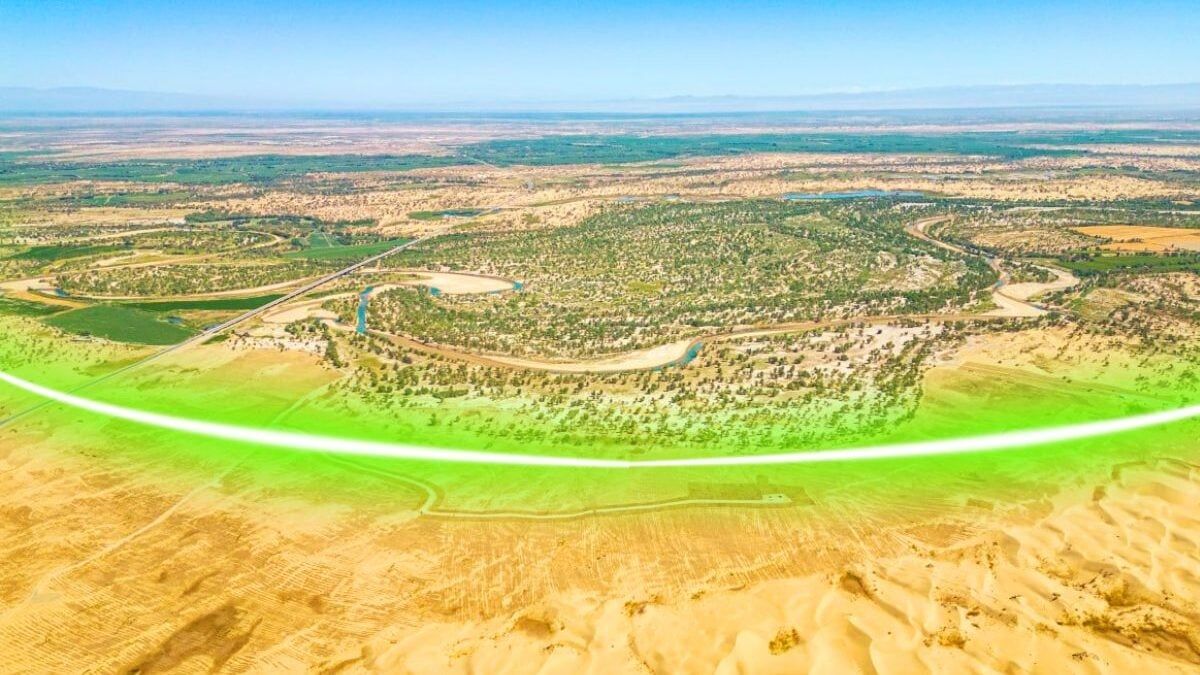
A titanic challenge facing the sand giant
The Taklamakan desert, nicknamed the “Sea of Death”, posed a growing threat with its 337,600 square kilometers of shifting dunes. Faced with this colossus of sand the size of Germany, China took up a major environmental challenge by creating a 3,050-kilometer green belt. This natural barrier, reinforced by innovative solar technologies, aims to control the formidable sandstorms that threaten the Xinjiang region.
Exceptional human mobilization over four decades
The scale of the project can be measured by the commitment of 600,000 people who worked for over 40 years. These builders methodically planted hardy plant species such as desert poplar, red willow and saxaul.
The first phase of the project, covering 2,761 kilometers, bears witness to remarkable perseverance in the fight against desertification.
Green innovation and economic development
The green belt is not limited to its ecological function. It generates unprecedented economic opportunities through the cultivation of medicinal plants such as the desert hyacinth.
The inauguration in 2022 of the Hotan-Ruoqiang railway line, the first rail loop around a desert, has created a vital 2,712-kilometer trade corridor for local products.
A renewable energy hub in the making
The project takes on a new dimension with the ambitious China Three Gorges Corporation program.
The planned installation of 8.5 gigawatts of solar power and 4 gigawatts of wind power will position Xinjiang as a leader in clean energy, transforming the desert into a source of green energy.
Inspiration for global reforestation projects
This Chinese success story is becoming an international model in the fight against desertification.
Similar initiatives, such as Africa’s Great Green Wall, are taking inspiration from this to develop their own ecological solutions.
236M views in 10 weeks: how KPop Demon Hunters dethroned Red Notice
Materialists Raises Eyebrows: Sharp Satire or Elitist Attack on Modern Love?
Park Chan‑wook’s 2025 Venice Comeback: 6‑Minute Ovation and a 20‑Year Return
Julia Roberts’ 6‑minute ovation at Venice 2025 — the quote already igniting awards talk
Conclusion
The transformation of the Taklamakan desert illustrates how a combination of long-term vision, human mobilization and technological innovation can reverse the advance of deserts.
This pioneering project paves the way for a new approach to environmental management, proving that with determination and ingenuity, even the most daunting ecological challenges can be overcome.
Source: JasonDeegan
Similar Posts
- China suspends megaproject the size of Germany, affecting 600,000 workers
- The miracle of the Colorado: how a dead river is coming back to life and what it will mean for millions of Americans
- 1700 sheep walk among solar panels: the result observed by researchers is incredible
- An unexpected revolution: How coal could become the future of electric cars – Experts are amazed
- At the age of 59, this engineer lived underwater for 120 days thanks to an ingenious breathing trick

A pop culture aficionado with a sharp eye for trends, Jason covers everything from Hollywood blockbusters to viral internet moments.